Filter Cake Press: Don't get caught slipping!

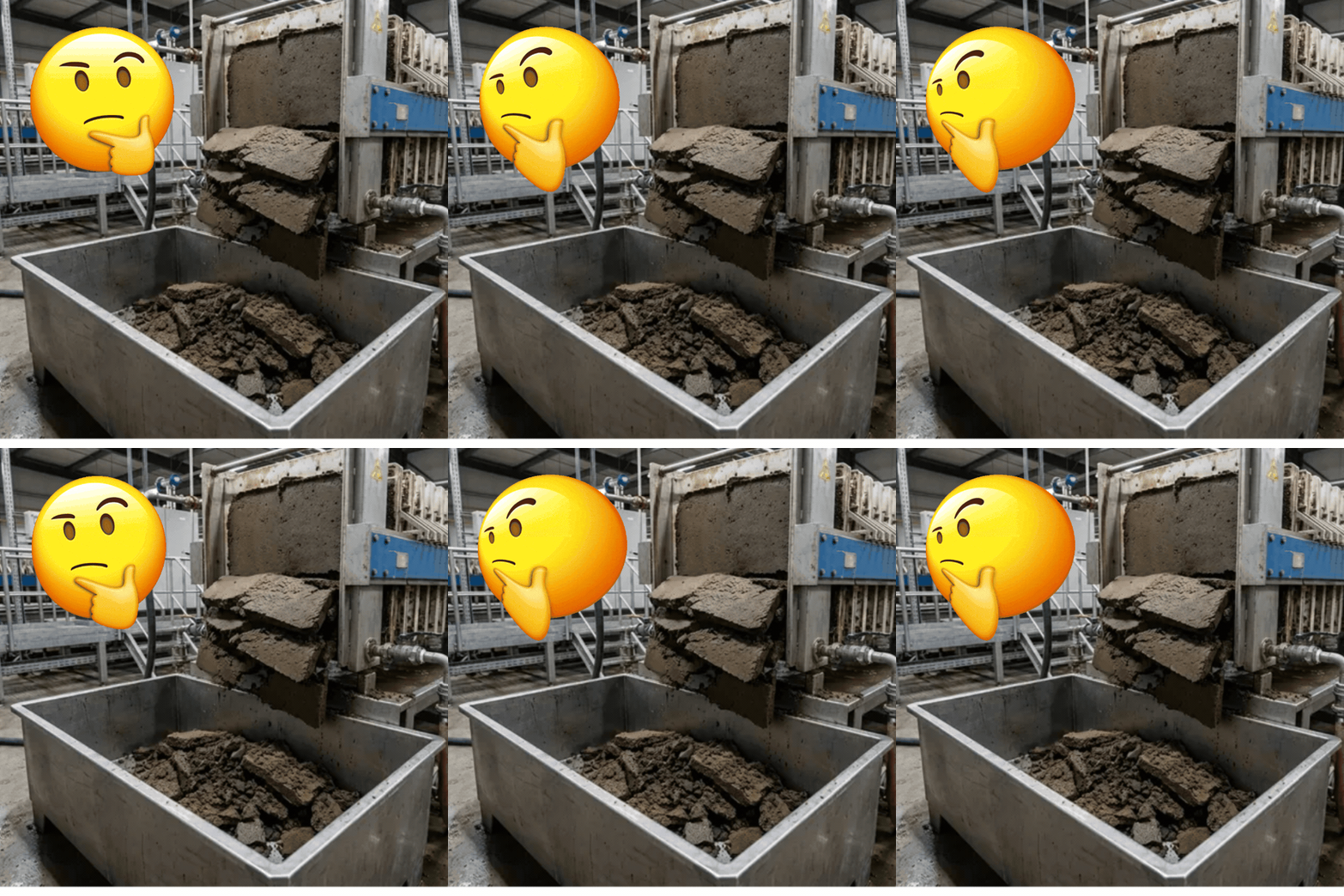
Industrial pretreatment systems in Texas tend to end the same way. The press cycles, the plates open, dewatered cake drops into a bin or roll-off staged underneath, an operator clears the corners, and a forklift swaps the container when it fills.
Ask a facility how that container is classified and the answer is usually one of two things: it is part of the wastewater treatment system, or it is a satellite accumulation area. In most cases neither characterization survives review, and the consequences show up in two separate places — the facility's Notice of Registration, and its employee exposure records.
The wastewater treatment unit exemption covers the press, not the bin
The wastewater treatment unit exemption is legitimate and widely relied upon, but it is narrower than most operators assume. Under 40 CFR §260.10, a WWTU must satisfy a three-part test. It must be part of a wastewater treatment facility subject to regulation under Clean Water Act §402 or §307(b). It must receive and treat or store an influent wastewater that is a hazardous waste, or generate and accumulate a wastewater treatment sludge that is a hazardous waste, or treat or store such a sludge. And it must meet the definition of a tank or tank system in §260.10. Texas applies the same three-part test, with the state definition extending to industrial solid waste as well as hazardous waste.
The third condition is where the analysis turns. EPA has read "tank" broadly for purposes of this exemption, expressly including presses, filters, sumps, and similar processing equipment (RO 12532, citing the July 31, 1981 Lehman memorandum to Region I). The filter press itself will generally qualify. A collection bin, tote, or roll-off will not, because it is not a stationary device and therefore is not a tank.
TCEQ has addressed this precise fact pattern. In Rule Interpretation Summary 260-10.002, the agency concluded that the WWTU exemption applies to the equipment comprising the unit and not to waste within or discharging from it; that a container receiving cake does not meet the tank definition and therefore cannot claim the exemption; and that the sludge becomes subject to regulation when it drops from the filter press into the container. EPA reached the same conclusion in RO 12532, noting that hazardous waste sludge removed from exempt units remains subject to manifesting, accumulation time limits, and related requirements.
The practical result is straightforward. The exemption ends at the discharge point of the press. What sits below it is a regulated container holding a newly generated waste.
Satellite accumulation is unavailable in most cases
Texas adopts the federal satellite accumulation provisions by reference at 30 TAC §335.53(d), which incorporates 40 CFR §262.15. Two independent lines of analysis defeat the SAA characterization, and which one applies depends on how the cake classifies.
If the cake is nonhazardous Class 1, satellite accumulation does not exist as an option. Section 262.15 is a hazardous waste provision. Texas provides no analogous allowance for Class 1, Class 2, or Class 3 industrial solid waste. A substantial share of filter cake classifies as Class 1 on metals content, pH, or an Appendix 1 constituent under 30 TAC Chapter 335, Subchapter R. Where that is the case, the storage unit belongs on the Notice of Registration and there is no alternative characterization to argue.
If the cake is hazardous, the volume limitation controls. Section 262.15(a) permits accumulation of up to 55 gallons of non-acute hazardous waste at or near the point of generation, under the control of the operator of the process. The regulation limits the volume accumulated rather than the rated capacity of the container, and I would recommend framing the analysis that way rather than litigating container size. The distinction has little practical effect here. A one-cubic-yard tote holds roughly 200 gallons; a 20-yard roll-off holds thousands. The 55-gallon threshold will be exceeded within one or two press cycles, at which point §262.15(a)(6) requires the excess to be marked with the date accumulation began and removed to a central accumulation area within three consecutive calendar days.
No facility operates a press on that cadence. What exists in practice is a central accumulation area subject to §262.17(a) for large quantity generators, ninety days, or §262.16(b) for small quantity generators, one hundred eighty days, as adopted at 30 TAC §335.53(f) and (e) respectively. Both are registered units.
Before selecting the applicable provision, complete the waste determination. F006 covers wastewater treatment sludges from electroplating operations, subject to six enumerated process exclusions, and is a listed waste. Cake that falls outside the listing frequently carries characteristic codes on TCLP results regardless.
C
onsequences on the Notice of Registration
Under 30 TAC §335.6(c)(1), any person, by site, generating in a calendar month more than 100 kilograms of non-acute hazardous waste, more than 1 kilogram of acute hazardous waste, or more than 100 kilograms of industrial Class 1 waste must register with the executive director. The resulting Notice of Registration identifies waste streams by eight-character Texas Waste Code and identifies on-site waste management units, each carrying a unit sequence number and a system type code describing how waste is managed in that unit.
Several obligations follow:
The container area requires a unit sequence number, typically as container storage, associated with the Texas Waste Codes it manages. Large quantity generators submit through STEERS. Small quantity generators may use STEERS or Form TCEQ-00002, which applies to non-permitted units only.
Notification obligations run on their own schedule. Section 335.6(b) imposes a duty to promptly notify the executive director of new information and of changes to previously submitted information, and §335.6(c)(4) requires notification within ninety days of such changes. Separately, §335.6(g) requires written notification at least ninety days before conducting any activity or facility expansion not authorized by permit. Adding a storage unit after an investigator identifies it is an avoidable finding.
Closure obligations attach to the unit. For large quantity generators, 40 CFR §262.17(a)(8), adopted at 30 TAC §335.53(f), imposes closure performance standards on waste accumulation units, including container units. Section 262.17(a)(8)(v) expressly exempts satellite accumulation areas from those standards — which is precisely why the SAA characterization is attractive and precisely why it must be correct. Pad construction, containment, and closure sampling are considerably cheaper to address at design than at decommissioning.
Outdoor placement introduces a second program. Cake exposed to precipitation constitutes exposure of significant materials under the TPDES Multi-Sector General Permit, and leachate migrating from the pad implicates 30 TAC §335.4 and Texas Water Code §26.121.
The exposure question
This is generally where environmental and safety programs stop coordinating.
Cake handling is episodic and short in duration. The drop, the container change-out, manual clearing of corners, and tarping are precisely the tasks that routine full-shift monitoring programs average away.
Particulate. Filter cake at 25 to 35 percent moisture generally has lower dust potential, but moisture alone does not eliminate the inhalation hazard. Air blow-dry cycles, extended dwell time, heat, material handling, and dry sweeping can increase airborne particulate. If the cake contains metals, substance-specific limits may apply instead of OSHA’s general particulate limits. Hexavalent chromium is particularly significant, with an OSHA PEL of 5 µg/m³ and action level of 2.5 µg/m³ as eight-hour TWAs. Lead and cadmium also have their own exposure, monitoring, and medical-surveillance requirements.
Gases and vapors. Sulfide-bearing sludge and cake can release hydrogen sulfide, particularly as pH decreases. OSHA sets a 20 ppm ceiling for H₂S, while ACGIH recommends much lower limits of 1 ppm TWA and 5 ppm STEL. Ammonia and VOCs may also be concerns depending on the wastewater chemistry and sludge composition. Pits, vaults, and similar areas may introduce additional atmospheric and confined-space hazards.
Assessment approach. Sample the tasks most likely to create exposure, including cake discharge, container change-out, drying, and cleanup, while also collecting representative full-shift samples where needed to evaluate eight-hour exposure limits. Gravimetric particulate, metals, and hexavalent chromium sampling can be paired with direct-reading instruments for H₂S, ammonia, VOCs, oxygen, and combustible atmospheres. Document the exposure determination, including negative results. A documented finding that exposure is below applicable limits is far more defensible than an assumption that exposure does not exist.
Controls, in order of preference:
Reduce cake dryness. Shortening or eliminating the air blow-dry step is the least expensive available dust control, offset against increased disposal weight.
Enclose the discharge point. Skirting between press and container, a fitted cover or lid, or a sealed roll-off.
Local exhaust ventilation at the discharge point, with a negative-pressure enclosure over the press bay where monitoring data support it.
Eliminate dry sweeping in favor of HEPA vacuum or wet methods.
Substitute mechanical handling for manual shoveling where the equipment layout permits.
Respiratory protection last. Routine reliance on respirators obligates a complete §1910.134 program.
Recommended verification
Two questions will resolve most of this. Does the container appear on the facility's Notice of Registration with a unit sequence number? Has any personal sampling been conducted on the employee positioned at the press during a discharge cycle?
Where the answer to both is no, two findings occupy the same twenty square feet of floor space.
Key citations
Point | Citation |
WWTU three-part definition | 40 CFR §260.10 |
Presses/filters/sumps treated as tanks for the exemption | EPA RO 12532 (Lehman memo, 7/31/1981) |
Container below press not exempt; sludge regulated on discharge | TCEQ RIS 260-10.002 |
Satellite accumulation, adopted in Texas | 30 TAC §335.53(d); 40 CFR §262.15 |
55-gallon limit; three-day removal of excess | 40 CFR §262.15(a), (a)(6) |
SQG / LQG central accumulation | 30 TAC §335.53(e), (f); 40 CFR §262.16(b), §262.17(a) |
Less-than-90-day storage permit exemption | 30 TAC §335.2(e) |
Registration thresholds and NOR | 30 TAC §335.6(c)(1) |
Duty to notify of new or changed information | 30 TAC §335.6(b), (c)(4) |
Ninety-day notice, activity or facility expansion | 30 TAC §335.6(g) |
LQG closure of accumulation units; SAA exclusion | 40 CFR §262.17(a)(8), (a)(8)(v) |
Waste classification | 30 TAC Chapter 335, Subchapter R |
General prohibitions | 30 TAC §335.4; Texas Water Code §26.121 |
PNOR limits | 29 CFR §1910.1000, Tables Z-1 and Z-3 |
Hexavalent chromium | 29 CFR §1910.1026 |
Hydrogen sulfide ceiling and peak | 29 CFR §1910.1000, Table Z-2 |